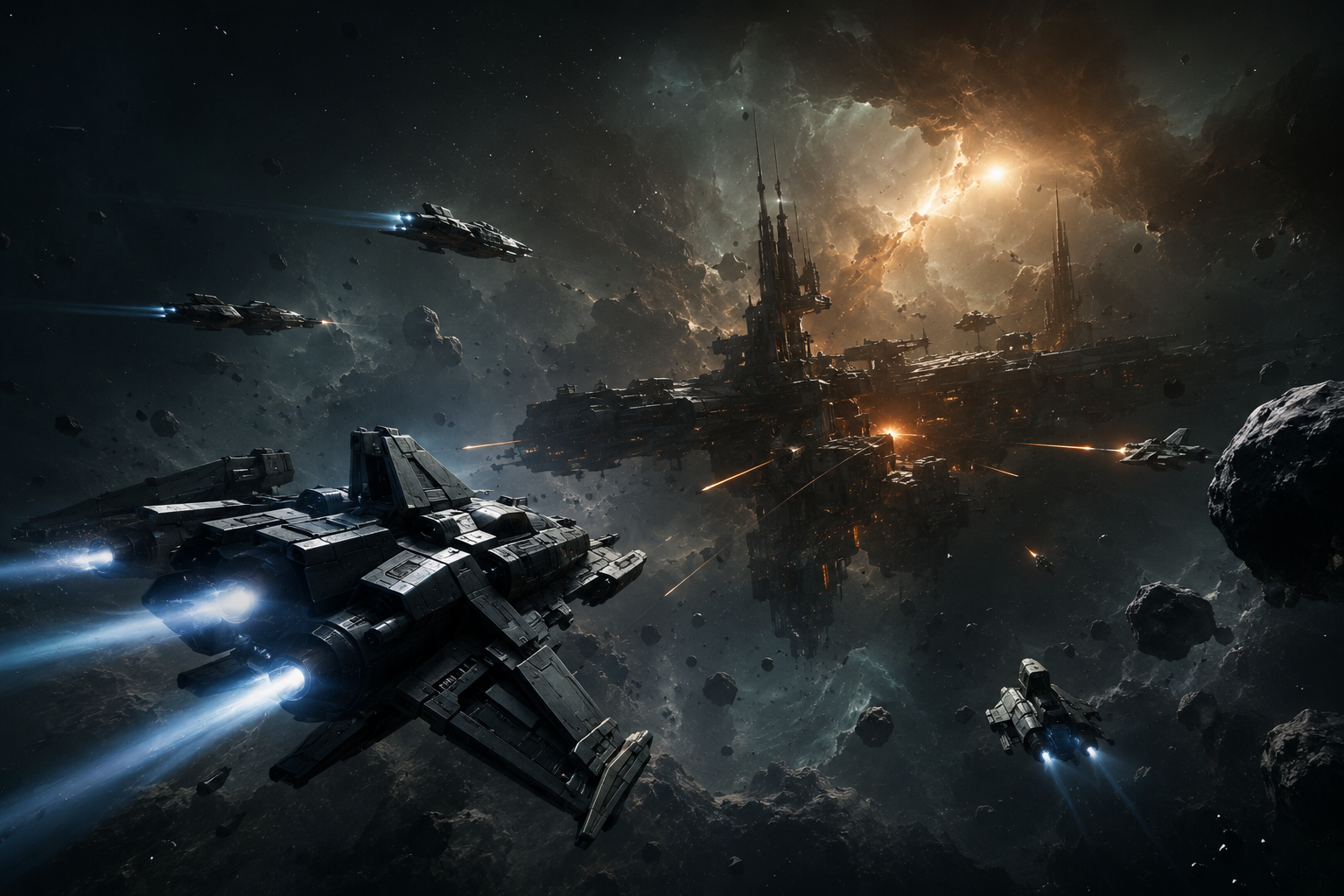
Player versus Environment operations are where Deadstar turns preparation into controlled violence. Combat sites, anomalies, missions, expeditions and hostile NPC-controlled space all become opportunities to build experience, resources and operational capability.
PvE is not simply about destroying whatever appears on the overview. It is about understanding the environment, choosing the right ship for the task, managing risk, and knowing when the objective is worth the exposure required to complete it.
Operational Brief
The PvE operation provides Deadstar pilots with a structured environment for developing combat capability while generating the resources necessary to sustain individual pilots and the corporation as a whole.
Operations may include combat anomalies, cosmic signatures, security missions, faction encounters, exploration combat sites, wormhole engagements against Sleepers, and other forms of NPC combat encountered during normal corporate activity.
The objective is not to chase every available target. The objective is to identify profitable and appropriate targets, establish the conditions for success, execute the operation cleanly, and return with the ship intact.
The Role of PvE
Every corporation needs resources. Ships need to be replaced. Modules need to be fitted. Ammunition needs to be manufactured or purchased. Pilots need the freedom to experiment, train and operate without constantly worrying about whether the next loss will end their ability to participate.
PvE provides one of the foundations for that independence.
Deadstar encourages its pilots to understand where their income comes from and how that income supports the larger organization. A successful PvE pilot is not simply accumulating ISK. They are building the financial and operational independence required to keep flying.
Combat Operations
Combat operations begin before the first weapon is fired.
Pilots are expected to understand the environment they are entering, the enemies they are likely to encounter, and the capabilities and limitations of the ship they are flying.
Before beginning an operation, pilots should consider:
- Enemy damage types and resistances
- Expected incoming damage
- Enemy electronic warfare capabilities
- Recommended engagement ranges
- Ship ammunition and capacitor requirements
- Escape routes and safe locations
- Potential player threats in the operating area
- The value of the objective compared with the risk involved
The strongest PvE pilot is not necessarily the pilot with the largest ship. It is the pilot who understands exactly what their ship can accomplish and refuses to create unnecessary risk.
Site Selection
Not every combat site deserves to be completed.
Deadstar pilots should learn to evaluate a site before committing a ship to it. Difficulty, expected payout, travel time, system security, local activity and the possibility of outside interference all influence whether an objective is worth pursuing.
A site that appears profitable on paper may become a poor operation if it requires excessive travel, exposes an expensive ship to unnecessary danger, or places the pilot in an environment they are not prepared to handle.
The correct question is not simply:
Is this site worth money?
The correct question is:
Is this site worth the risk, time and resources required to complete it?
Mission Operations
Security missions provide a controlled environment for developing combat fundamentals. They allow pilots to learn how their ships perform against predictable groups of enemies while building standing, income and practical combat experience.
Mission running can also serve as a useful training environment for newer pilots who are still learning range control, target prioritization, weapon application, capacitor management and tank management.
Pilots should learn to recognize when a mission is routine and when an objective presents an unacceptable level of risk for the ship being used. Declining or postponing an operation is preferable to losing a ship because the pilot refused to recognize changing circumstances.
Combat Anomalies
Combat anomalies offer a more dynamic form of PvE. They can be discovered quickly, completed independently, and incorporated into larger roaming or resource-gathering operations.
Anomalies are particularly useful when pilots are operating in systems that already support other Deadstar activities. A pilot can generate income while simultaneously becoming familiar with the surrounding system and watching for changes in local activity.
PvE should never make a pilot blind.
The overview remains part of the battlefield. Directional scanning, local intelligence where available, probes, bookmarks and situational awareness remain important even when every visible hostile is an NPC.
Exploration Combat
Exploration and PvE frequently overlap.
Combat sites discovered through scanning can provide valuable opportunities while encouraging pilots to develop skills that transfer directly into wormhole operations and other forms of exploration.
Pilots participating in exploration-based PvE should understand how to scan signatures, identify site types, bookmark useful locations and maintain enough awareness to recognize when another pilot has entered the same operational environment.
The ability to move from scanning to combat without losing situational awareness is a core Deadstar capability.
Wormhole PvE
Wormhole space changes the equation.
There is no conventional local intelligence to rely upon in the same way pilots may be accustomed to in known space. Hostile NPCs can be dangerous, but another capsuleer is often the greater threat.
Sleeper combat therefore requires two forms of awareness at once: awareness of the site and awareness of the system surrounding it.
Before beginning a site, pilots should establish appropriate bookmarks, understand the current wormhole chain, identify useful exits and maintain an escape option.
A profitable site is never worth becoming complacent.
Deadstar’s PvE operation works closely with the corporation’s wormhole and exploration activities because the skills developed in one environment directly improve performance in the other.
Target Priority
Effective PvE combat depends on understanding which targets actually matter.
Pilots should prioritize threats according to the effect they have on the operation rather than simply attacking the largest target on grid.
- Electronic warfare threats
- Warp disruption and scrambling threats
- High-damage enemies
- Fast tackle or close-range targets
- Logistics or support units
- Remaining combat ships
Target priority will vary depending on the site and the ship being flown. The important principle is to understand why a target is being engaged before committing weapons to it.
Fleet PvE
Not every PvE operation needs to be performed alone.
Fleet operations allow pilots with different ships and skill levels to contribute to a common objective. A properly organized fleet can complete difficult content more efficiently while providing newer pilots with an opportunity to learn from experienced members.
Fleet PvE may include dedicated damage dealers, logistics support, electronic warfare, scouting, salvaging and command roles depending on the objective.
Every pilot should understand their assigned role before the fleet begins. Confusion during combat wastes time and can turn a manageable site into a preventable loss.
Salvage and Recovery
The operation does not necessarily end when the last hostile disappears.
Salvage, loot recovery and site completion can represent a significant portion of the final value of an operation. Pilots should therefore understand what has value, what should be recovered, and what can safely be left behind.
Salvaging also provides an additional role for pilots who may not yet have the combat capability required to participate directly in the initial engagement.
Deadstar values participation wherever a pilot can contribute meaningfully.
Risk Management
PvE is predictable until it isn’t.
The moment another capsuleer enters the equation, the operation can change completely. A pilot who has spent twenty minutes clearing a site may be tempted to stay because of the time already invested. That instinct is exactly what creates unnecessary losses.
Pilots are expected to recognize changing circumstances and disengage when appropriate.
There is no shame in abandoning a site.
There is considerably less value in losing a ship because the pilot refused to leave an objective that had stopped being safe.
Ship Discipline
Every ship has a purpose.
Pilots should use ships appropriate to the difficulty of the content rather than automatically selecting the most expensive hull available to them.
A properly fitted and appropriately flown cruiser can be more valuable to an operation than an expensive battleship flown beyond its practical limits.
Deadstar encourages pilots to develop several levels of capability:
- A reliable entry-level combat platform
- A stronger platform for advanced PvE
- A specialized ship for particular environments
- A fleet-capable platform for organized operations
- An economical replacement option for unexpected losses
The goal is flexibility rather than dependency on a single hull.
What PvE Pilots Are Expected to Know
PvE pilots should progressively develop the ability to:
- Fit a ship appropriately for its intended environment
- Understand basic NPC damage and resistance mechanics
- Manage range and weapon application
- Manage capacitor and tank
- Prioritize targets
- Recognize dangerous NPC mechanics
- Evaluate the profitability of an objective
- Recognize when an operation should be abandoned
- Maintain situational awareness while engaged in PvE
- Operate safely around other capsuleers
- Work effectively within a fleet
- Recover and evaluate loot and salvage
What You Will Learn
Combat fundamentals, PvE ship fitting, target prioritization, damage application, tank management, site evaluation, mission running, anomaly operations, exploration combat, fleet coordination and practical risk management.
More importantly, pilots learn the discipline required to turn PvE from a repetitive activity into a reliable operational capability.
Operational Standards
Deadstar does not expect every pilot to begin with the same skills, equipment or experience.
We do expect pilots to learn.
Ask questions. Test fits. Learn why a ship works rather than simply copying somebody else’s configuration. Learn from losses instead of hiding them. Share useful information with other pilots.
A pilot who improves the capability of everyone around them contributes more to Deadstar than a pilot who simply generates the highest personal income.
Intel Brief
PvE activity should be treated as an operational environment rather than a private bubble disconnected from the rest of the corporation.
Valuable information discovered during PvE can benefit other Deadstar operations. Unusual activity, hostile pilots, useful systems, profitable sites, dangerous locations and changes in local conditions should be communicated when appropriate.
A pilot running a combat site may be generating ISK, but they are also observing the environment.
Every operation produces information.
Information shared becomes capability.
Success Is More Than ISK
Income matters. It keeps pilots flying.
But the true measure of a successful PvE operation is broader.
Did the pilot complete the objective safely? Did they learn something? Did they improve their ship or fitting knowledge? Did they contribute to another pilot’s development? Did they identify useful intelligence? Did they return with more resources than they started with?
If the answer to those questions is yes, the operation succeeded.
The Deadstar Approach
We do not run PvE simply because there are NPCs waiting to be destroyed.
We run it because every completed operation makes the corporation stronger.
Every ship earned gives a pilot another opportunity to fly. Every skill learned expands what that pilot can contribute. Every profitable operation creates another resource for the corporation. Every mistake understood becomes experience that can prevent the next loss.
The objective is simple:
Fly prepared. Know the risk. Complete the objective. Bring the ship home.
Then do it again.